We've just uploaded our latest publication on Rhynie to the website - you can find it in the Reading and More Information page (look right!).
Gondek, M. and Noble, G. 2017. Rhynie: New Perspectives on Settlement in Pictland in the 5th and 6th centuries AD and the Context of Pictish Symbol Stones, in S. Semple, C. Orsini and S. Mui (eds) Life on the Edge: Social, Political and Religious Frontiers in Early Medieval Europe, Braunschweig: Braunschweigisches Landesmuseum (Neue Studien zur Sacsenforschung Band 6), pp. 59 - 69.
Free Access with that link.
Happy reading!
Rhynie, Aberdeenshire

The Craw Stane with Tap o'Noth hillfort in the background (Photo courtesy of Cathy MacIver).
Tuesday, 9 January 2018

Wednesday, 13 September 2017
Rhynie Video
Many of our regular followers will already know of this great short film with some fantastic photography and reconstruction. However, if you have not already seen it - it is worth a visit!

We're all now back in our offices after the field season (except Cathy who is probably up a different hillfort). We'll endeavor to get those final trench updates online in the nearish future.
Many thanks to all in the village for their support and enthusiasm again this year.

We're all now back in our offices after the field season (except Cathy who is probably up a different hillfort). We'll endeavor to get those final trench updates online in the nearish future.
Many thanks to all in the village for their support and enthusiasm again this year.
Monday, 28 August 2017
A bit of 'Rhynie Curse' and a great big ditch
All trenches continue with great gusto despite a visit from the 'Rhynie Curse' which this year has shown itself in:
1 case of 'poison finger'
1 incident of Land Rover grounding
1 incident of said Land Rover bursting a tire
1 case of chicken pox
many incidents of sore muscles and for some reason sore heids amongst some of the team...
Updates from the hillforts are pending as I await some photographs and text from the teams up there (they aren't stuck up there, just too exhausted to blog).
By the Craw Stane things are moving well.
We continue to find evidence of non-ferrous metalworking and the high-life led by the inhabitants. Some of the most exciting finds this year are 3 tiny sherds of glass, which are from imported Continental drinking vessels. We are also continuing to find sherds of a blackish pottery, probably hand-made; we found a few fragments of this last year, too. This pottery could be very important as traditionally the Picts are aceramic (despite knowing all the technology perfectly well as evidenced by the ceramic crucible sherds).
We've spend the last few days concentrating on the story of the outer ditch - and what a ditch it is!
We still have not definitively bottomed the outer ditch (but are close we think). We are stopping now to do some recording to ensure the safety of the team and to enable us to remove at least the upper layers of the baulk soon. We have what looks like a cut (possibly for a drain as there was stone as a type of potential 'lining,' but as the soil drains very well here this seems a little unnecessary even in the ditch). This is at the bottom of the ditch and potentially represents a recutting event, which we should be able to confirm once we can continue excavating down in more safety.
Other exposed areas of the ditch are still in middle fill levels, but we are seeing some features including a few shallow pits of unknown purpose. The larger pit we suspect might be an event related to digging out sand, perhaps for metalworking-related activities. We are in the final week now. Weather will hopefully hold out, although the wind is picking up and so is the sand down at the Craw Stane trench (next stop for the 'curse' is probably conjunctivitis...). I might be a bit sad to leave my office (below) - but perhaps I can set up a similar situation at Chester inside my own office.
1 case of 'poison finger'
1 incident of Land Rover grounding
1 incident of said Land Rover bursting a tire
1 case of chicken pox
many incidents of sore muscles and for some reason sore heids amongst some of the team...
 |
| Who knew you could drink a G&T from an amphora?!? |
Updates from the hillforts are pending as I await some photographs and text from the teams up there (they aren't stuck up there, just too exhausted to blog).
By the Craw Stane things are moving well.
 |
| A selection of finds - look at that sherd of amphora - as big as yer face! |
We continue to find evidence of non-ferrous metalworking and the high-life led by the inhabitants. Some of the most exciting finds this year are 3 tiny sherds of glass, which are from imported Continental drinking vessels. We are also continuing to find sherds of a blackish pottery, probably hand-made; we found a few fragments of this last year, too. This pottery could be very important as traditionally the Picts are aceramic (despite knowing all the technology perfectly well as evidenced by the ceramic crucible sherds).
We've spend the last few days concentrating on the story of the outer ditch - and what a ditch it is!
 |
| Ditch fills looking fab. |
Other exposed areas of the ditch are still in middle fill levels, but we are seeing some features including a few shallow pits of unknown purpose. The larger pit we suspect might be an event related to digging out sand, perhaps for metalworking-related activities. We are in the final week now. Weather will hopefully hold out, although the wind is picking up and so is the sand down at the Craw Stane trench (next stop for the 'curse' is probably conjunctivitis...). I might be a bit sad to leave my office (below) - but perhaps I can set up a similar situation at Chester inside my own office.
 |
| A bru and a bucket - what more does an office need? |
Monday, 21 August 2017
A fine day (and a visit from Fred)
Thankfully today was a lot less wet meaning everyone's spirits were improved. Up on Wheedlemont, however, reports are that the work is a bit hard-going with some pretty tough ground lying underneath the turf. Exciting glimpses of structures within the hillfort at Tap o'Noth are also emerging.
Down in the village we managed a good day's work despite the lure of Rhynie Woman's pop up cafe (cinnamon buns!).
Hard work was rewarded with some lovely ditch fills and a lunchtime visit from Fred.

A few more fragments of clay moulds used for casting pins also emerged. So our evidence for fine metalworking continues to grow.
Our Open Day should be this coming Saturday (weather permitting) and there are activities ongoing in the village this week (see Rhynie Woman's facebook page for more info).
Down in the village we managed a good day's work despite the lure of Rhynie Woman's pop up cafe (cinnamon buns!).
Hard work was rewarded with some lovely ditch fills and a lunchtime visit from Fred.

As we moved into the fills, finds also emerged. Irving hit the pottery jackpot with some lovely big sherds of what looks like Late Roman Amphora (5th - 6th c AD) as well as crucible fragments for melting non-ferrous metals such as bronze.
 |
| Sherds of probably LRA found today. |
 |
| Sieving action! |
Our Open Day should be this coming Saturday (weather permitting) and there are activities ongoing in the village this week (see Rhynie Woman's facebook page for more info).
 |
| Not a bad view from the office - I can wave to the crew on Tap o'Noth. |
Saturday, 19 August 2017
REAP2017 is underway
And we're off....
This year's excavations began in earnest yesterday (wet) and we have three! trenches (wet) this year. At the Craw Stane is what would be considered by our usual standards a wee trench barely big enough to swing a Rhynie Man axe. This trench is targeting the outer ditch (windy, wet) and is now being cleaned by a small, dedicated (wet) team.
A slightly more unhinged group is up on a hill investigating a fort at Wheedlemont. This is an evaluation (windy and even more wet) to ascertain the character of the site and hopefully obtain some dating evidence to see if it might be contemporary with our Pictish complex at the Craw Stane and down by the village of Rhynie.
A really unhinged (soaking wet, hail) team is up on the glorious hill fort at Tap o'Noth and this is another evaluation to determine what excavation might be like up there (probably wet, definitely windy) and to investigate the potential for possible future work and chance of obtaining dateable materials.
So a very different type of year for us here. We hope to be able to update you on all three sites fairly regularly and to gradually update some of the behind the scenes pages here too with links and more information.
Daily tweets and Facebook posts can also be found on the Northern Picts project account/pages for those of you needing to get a fix and see pictures of us in action on an hourly basis. Some of you may have spotted Dr GN's snazzy blue Pictish prince catsuit courtesy of Rhynie Woman in honour of the gala day yesterday. What has been seen, cannot be unseen!
Despite a bit of a wet start, we hope for some dry spells over the next few days and that lots of great archaeology will be revealed.
This year's excavations began in earnest yesterday (wet) and we have three! trenches (wet) this year. At the Craw Stane is what would be considered by our usual standards a wee trench barely big enough to swing a Rhynie Man axe. This trench is targeting the outer ditch (windy, wet) and is now being cleaned by a small, dedicated (wet) team.
A slightly more unhinged group is up on a hill investigating a fort at Wheedlemont. This is an evaluation (windy and even more wet) to ascertain the character of the site and hopefully obtain some dating evidence to see if it might be contemporary with our Pictish complex at the Craw Stane and down by the village of Rhynie.
A really unhinged (soaking wet, hail) team is up on the glorious hill fort at Tap o'Noth and this is another evaluation to determine what excavation might be like up there (probably wet, definitely windy) and to investigate the potential for possible future work and chance of obtaining dateable materials.
So a very different type of year for us here. We hope to be able to update you on all three sites fairly regularly and to gradually update some of the behind the scenes pages here too with links and more information.
Daily tweets and Facebook posts can also be found on the Northern Picts project account/pages for those of you needing to get a fix and see pictures of us in action on an hourly basis. Some of you may have spotted Dr GN's snazzy blue Pictish prince catsuit courtesy of Rhynie Woman in honour of the gala day yesterday. What has been seen, cannot be unseen!
Despite a bit of a wet start, we hope for some dry spells over the next few days and that lots of great archaeology will be revealed.
Wednesday, 31 August 2016
Pretty little moulds all in a row
An early morning post before we head out for the day. Remember, if you are visiting site today we will be very busy trying to wrap everything up, but we will try to stop for a chat.
Hard to believe we are almost done. What an amazing season. We'll update about our post-ex progress and especially about some of these magical moulds once they have been cleaned and analysed. We are hoping some are complete enough to have 3D scanned and then 3D printed so we can try casting our own Pictish metalwork!
 |
| Just a selection of finds from the past few days drying out. |
Hard to believe we are almost done. What an amazing season. We'll update about our post-ex progress and especially about some of these magical moulds once they have been cleaned and analysed. We are hoping some are complete enough to have 3D scanned and then 3D printed so we can try casting our own Pictish metalwork!
Tuesday, 30 August 2016
Racing to the finish..
We'll be finishing up work this week on site. The mad rush of finishing features and recording them is well under way (with the joy of backfilling looming large in the near future).
The inner ditch sondage has been completed - almost single-handedly by Irving with some help from Jasmin. The sections tell us a story about how they attempted to stabilise the ditch with layers of turf as it filled in.
Work in the outer ditch sondages progressed rapidly in both trench 1 and 2. Yesterday a massive dump of metalworking waste was uncovered in trench 2 quite far down in the ditch. Over 100 fragments of clay moulds were uncovered and many of these were of exceptional quality. We are sitting now with torches and magnifying glass trying to get to grips with the range of objects that were made. Trench 1 also continued to produce finds of metalworking moulds and crucibles.
One of the real highlights today and of the entire dig has nothing to do with artefacts. Today the puzzle of how they constructed the outer palisade/wall walk type structure was revealed. At the base of a very deep thin trench we found the ghosts of planks and posts preserved more clearly than ever before.
We have been puzzling over the palisade construction for years. The sheer scale of the size of construction and the skill and effort taken in making the wooden planks and posts for this structure is astounding.
We only have one full day in the field left, but we are extremely satisfied with our work this year - so many great successes and a lot of 'firsts' for Pictish archaeology.
The inner ditch sondage has been completed - almost single-handedly by Irving with some help from Jasmin. The sections tell us a story about how they attempted to stabilise the ditch with layers of turf as it filled in.
Work in the outer ditch sondages progressed rapidly in both trench 1 and 2. Yesterday a massive dump of metalworking waste was uncovered in trench 2 quite far down in the ditch. Over 100 fragments of clay moulds were uncovered and many of these were of exceptional quality. We are sitting now with torches and magnifying glass trying to get to grips with the range of objects that were made. Trench 1 also continued to produce finds of metalworking moulds and crucibles.
One of the real highlights today and of the entire dig has nothing to do with artefacts. Today the puzzle of how they constructed the outer palisade/wall walk type structure was revealed. At the base of a very deep thin trench we found the ghosts of planks and posts preserved more clearly than ever before.
 |
| The grey shadows of squared planks set at the edge of the palisade with large posts set behind. |
We only have one full day in the field left, but we are extremely satisfied with our work this year - so many great successes and a lot of 'firsts' for Pictish archaeology.
Sunday, 28 August 2016
Mould Magic
First off a massive thank you to everyone that came out to support us and Rhynie Woman at the ceilidh last night. We jigged, we jagged... we stripped a willow or two. It was a great night!
And now to mould magic...
It can be difficult to explain to people why we get so excited about moulds as sometimes they aren't much to look at. Almost all the moulds we have found have been clay two-part moulds. These types of moulds have to be broken to get out the metal object, which is why they are in fragments. Since they are 'one use only' objects, the clay is not fired as hard as when making pottery, usually, which also means they fragments can break down and decay more easily than pots. Despite all these issues, we have amassed a great collection of moulds. Most are for the shafts of pins, probably to hold clothing. The most exciting moulds show us the pin head, which helps us identify what type of pin it was. We have to be very careful with the moulds as too much handling or brushing can break or remove the detail. Once in a while we get a real gem without too much handling!
This morning a lovely mould emerged. The mould looks to be for an early type of handpin, one of those quite rare types of pins for early medieval Scotland.
Today was our Open Day and we had lots of interest from visitors until the rain poured down during our lunch break. Thankfully most of us were off site having our lunch and the rainclouds parted after a while and the afternoon was fantastic for digging.
And now to mould magic...
It can be difficult to explain to people why we get so excited about moulds as sometimes they aren't much to look at. Almost all the moulds we have found have been clay two-part moulds. These types of moulds have to be broken to get out the metal object, which is why they are in fragments. Since they are 'one use only' objects, the clay is not fired as hard as when making pottery, usually, which also means they fragments can break down and decay more easily than pots. Despite all these issues, we have amassed a great collection of moulds. Most are for the shafts of pins, probably to hold clothing. The most exciting moulds show us the pin head, which helps us identify what type of pin it was. We have to be very careful with the moulds as too much handling or brushing can break or remove the detail. Once in a while we get a real gem without too much handling!
This morning a lovely mould emerged. The mould looks to be for an early type of handpin, one of those quite rare types of pins for early medieval Scotland.
 |
| Proto handpin mould. |
Today was our Open Day and we had lots of interest from visitors until the rain poured down during our lunch break. Thankfully most of us were off site having our lunch and the rainclouds parted after a while and the afternoon was fantastic for digging.
Thursday, 25 August 2016
Crammed wtih crucibles....
Another brilliant day on site.
About two minutes into the day, the first sherd of crucible was found. They just kept coming. We have rim sherds, base fragments and lots of body sherds.
Metalworking is definitely the big theme from this year's excavations. We appear to have come across a distinctive dump of debris from metalworking. The finds are very broken, some degrading and they are all mixed up. Many people might not get that excited about metalworking evidence (preferring instead the shiny final products), but we can't get enough of our clay moulds!
Another fantastic mould for a hand pin emerged today showing the front half of the mould with the little projecting fingers very clearly outlined. Fantastic. It didn't photograph very well so we are a little short on eye candy... apologies! It is clear they were making a range of different types of pins and brooches as well as other metal objects at Rhynie. Having the production evidence for these objects is actually more important than having the final shiny pieces; it tells us much more!
Remember our open day is happening this weekend - Sunday - and we'll post more information on Saturday including times and activities.
About two minutes into the day, the first sherd of crucible was found. They just kept coming. We have rim sherds, base fragments and lots of body sherds.
Metalworking is definitely the big theme from this year's excavations. We appear to have come across a distinctive dump of debris from metalworking. The finds are very broken, some degrading and they are all mixed up. Many people might not get that excited about metalworking evidence (preferring instead the shiny final products), but we can't get enough of our clay moulds!
Another fantastic mould for a hand pin emerged today showing the front half of the mould with the little projecting fingers very clearly outlined. Fantastic. It didn't photograph very well so we are a little short on eye candy... apologies! It is clear they were making a range of different types of pins and brooches as well as other metal objects at Rhynie. Having the production evidence for these objects is actually more important than having the final shiny pieces; it tells us much more!
Remember our open day is happening this weekend - Sunday - and we'll post more information on Saturday including times and activities.
Wednesday, 24 August 2016
Another fine day.. or should that be FIND day...
The investigations into the outer ditch are exceeding our expectations. Our main research questions focusing on this feature this year are to look for more information on the different types of activities occurring on site during the 5-6th century AD and to establish more definitively whether there is a recut (a reworking) of the outer ditch.
We have not dug down deep enough yet to answer the second objective, but we are certainly able to already shed more light on what went on at the Craw Stane complex.
They drank!
Today both another sherd of a glass drinking vessel and fragments, including a handle, of Late Roman Amphora emerged from the ditch fill.
They melted stuff!
Whilst we knew some of this before from our earlier excavations, the range and quantity of metalworking material is something we have not encountered here before.
We have not dug down deep enough yet to answer the second objective, but we are certainly able to already shed more light on what went on at the Craw Stane complex.
They drank!
Today both another sherd of a glass drinking vessel and fragments, including a handle, of Late Roman Amphora emerged from the ditch fill.
 |
| Sherd of early medieval glass from Rhynie. |
We have over 50 sherds of crucibles now and of many different types. We even have evidence now of firing enamel for decoration of pins and brooches. So far this year we have two droplets of copper alloy.
They made lots of pins!
We have many clay moulds - mostly showing the shafts of pins. However, today two special bits of mould fragment turned up. Both of these look like they could be a mould for a hand pin - a very distinctive and beautiful pin in use during the 5th-6th centuries mostly in Scotland and Ireland.
 |
| Doesn't look like much, but a possible mould for a hand pin from Rhynie. |
Whilst we knew some of this before from our earlier excavations, the range and quantity of metalworking material is something we have not encountered here before.
Tuesday, 23 August 2016
Mini-Diggers on Site
Today we had the rest of Rhynie Primary with us on site. They did a great job trowelling in Trench 5 and sieving for treasures.
Despite gloomy forecasts we didn't get more than a few drops of rain today. Perfect digging weather!
The outer ditch continues to provide us with lots of metalworking evidence including today another fragment of a stone crucible stand or mortar with some possible red enamel and copper alloy stuck to it. We had some great mould fragments for pins, too.
In Trench 4, work on one of the palisade postholes revealed a cache of unburnt bone (cattle) in the post-pipe. We had a similar cache of bone in another palisade posthole in 2012 - and that feature had a lovely brooch mould at the bottom. We await this posthole's excavation with anticipation!
And just in case you thought we were all business this year.... Here is Dan modelling Oskar's solution to trample in our nice clean trenches.

Despite gloomy forecasts we didn't get more than a few drops of rain today. Perfect digging weather!
The outer ditch continues to provide us with lots of metalworking evidence including today another fragment of a stone crucible stand or mortar with some possible red enamel and copper alloy stuck to it. We had some great mould fragments for pins, too.
 |
| Digging the outer ditch in the shadow of Tap o'Noth. |
In Trench 4, work on one of the palisade postholes revealed a cache of unburnt bone (cattle) in the post-pipe. We had a similar cache of bone in another palisade posthole in 2012 - and that feature had a lovely brooch mould at the bottom. We await this posthole's excavation with anticipation!
 |
| Lifting the animal bone in a palisade posthole. |
And just in case you thought we were all business this year.... Here is Dan modelling Oskar's solution to trample in our nice clean trenches.

Monday, 22 August 2016
I'll drink to that...
Some eye candy for those that like a bit of drinking glass...
 |
| Rim of probably 5th-6th century glass drinking vessel from Rhynie. |
Update: Crucible Kings and Pin Princessess
Rhynie 2016 is well under way and we had our first visit from Rhynie Primary today. Our two teams - 'The Archaeologists' and 'The Picts' - did a bit of detective work with aerial photography, got a first hand look at the amazing finds we have on site so far and got their hands dirty in Trench 5 doing a bit of trowelling back and sieving. Wouldn't you know it they found TWO flint flakes in the topsoil?!? Those keen young eyes...
The big developments over the past few days have been the number and quality of finds. Since we started excavating features, the finds have been popping up all over the place.
Highlights include numerous crucible sherds - largely found by Curtis and Lewis in the outer ditch. Crucibles are small clay pots used to melt precious metals like bronze for making items such as pins and brooches in the Pictish period. To complement all those sherds we have a potential crucible stand and a growing number of moulds for pins and other objects.
Not to be overshadowed by the lads in the outer ditch, Vicky became our first pin princess by finding a lovely fragment of a copper alloy pin. The pin looks purposefully bent or broken and is reminiscent of a bent nail-headed pin from the site.
A few sherds of amphorae have also emerged, but this year the focus really seems to be on metalworking debris (at least so far!).
The big find of the day was also the most delicate - a lovely rim of a glass drinking vessel. Roland (looking unimpressed apparently) was heading towards Gordon with glass in hand when Dr GN started the dance of joy - Daniel said it made his year! This adds to our small but important collection of fine glass drinking vessels.
We should be having an open day on Sunday this weekend so keep your eyes posted on the blog and the Northern Picts facebook page (for those that do that sort of thing!).
The big developments over the past few days have been the number and quality of finds. Since we started excavating features, the finds have been popping up all over the place.
Highlights include numerous crucible sherds - largely found by Curtis and Lewis in the outer ditch. Crucibles are small clay pots used to melt precious metals like bronze for making items such as pins and brooches in the Pictish period. To complement all those sherds we have a potential crucible stand and a growing number of moulds for pins and other objects.
 |
| Possible stone crucible stand. |
Not to be overshadowed by the lads in the outer ditch, Vicky became our first pin princess by finding a lovely fragment of a copper alloy pin. The pin looks purposefully bent or broken and is reminiscent of a bent nail-headed pin from the site.
A few sherds of amphorae have also emerged, but this year the focus really seems to be on metalworking debris (at least so far!).
The big find of the day was also the most delicate - a lovely rim of a glass drinking vessel. Roland (looking unimpressed apparently) was heading towards Gordon with glass in hand when Dr GN started the dance of joy - Daniel said it made his year! This adds to our small but important collection of fine glass drinking vessels.
We should be having an open day on Sunday this weekend so keep your eyes posted on the blog and the Northern Picts facebook page (for those that do that sort of thing!).
Friday, 19 August 2016
2016 Season begins!
We are well into cleaning the trenches and revealing our familiar features as well as some tantalising new features. The inner and outer ditches look great as does the palisade and the ring of palisade postholes. We have one small sherd of Late Roman Amphora so far from cleaning.
The students and volunteers not to mention the staff are looking forward to the next few weeks of back breaking labour, banter and careful trowelling. Rhynie Woman is providing the best lunches for us EVER (ah, the cakes!).
Most of us are heading to the Prize Bingo tonight and there will be tours tomorrow during Rhynie Gala. Meet near the Gala tents in the village during the afternoon!
The students and volunteers not to mention the staff are looking forward to the next few weeks of back breaking labour, banter and careful trowelling. Rhynie Woman is providing the best lunches for us EVER (ah, the cakes!).
Most of us are heading to the Prize Bingo tonight and there will be tours tomorrow during Rhynie Gala. Meet near the Gala tents in the village during the afternoon!
 |
| Drone shot of our trenches 2016. |
Friday, 12 August 2016
Rhynie does it again... in Iron.
So says our finds expert Ewan Campbell... here is a lovely shot of our disc-headed iron pin from last year's excavations. All those mutterings of 'pin-like' by Dan and myself proved to be right (virtual high five Daniel!).
Just something to whet your whistle for what hopes to be a productive season starting next week.
Rhynie, here we come!

Just something to whet your whistle for what hopes to be a productive season starting next week.
Rhynie, here we come!

Friday, 24 June 2016
2016 Season Dates!
Wow, is it summer 2016 already?
The REAP team are excited to be returning for another season of work at the Craw Stane (permissions pending). We should be beginning work on site 15th of August for 2-3 weeks. We've got lots of work to do and lots of exciting activities on site (and off...) in the planning.
Some of you may have seen Rhynie featured on BBC's Digging for Britain Series 4 (North episode) http://www.bbc.co.uk/programmes/b074hn34. Alas, it is not available for viewing on iPlayer - but if you saw it make sure you tease Gordon!
Last year DipIn video also stopped by (alas Gordon was busy with other filming so I had to step up... although I like the classic Scottish archaeologist combination of sun hat and waterproof I'm sporting!). Rhynie is featured in the History & Heritage video http://www.dipinvideo.co.uk/videos/picts - watch the whole thing but Rhynie begins around 7 minutes in.
Looking forward to standing in the shadow of the Craw Stane soon.
Dr M.
The REAP team are excited to be returning for another season of work at the Craw Stane (permissions pending). We should be beginning work on site 15th of August for 2-3 weeks. We've got lots of work to do and lots of exciting activities on site (and off...) in the planning.
Some of you may have seen Rhynie featured on BBC's Digging for Britain Series 4 (North episode) http://www.bbc.co.uk/programmes/b074hn34. Alas, it is not available for viewing on iPlayer - but if you saw it make sure you tease Gordon!
Last year DipIn video also stopped by (alas Gordon was busy with other filming so I had to step up... although I like the classic Scottish archaeologist combination of sun hat and waterproof I'm sporting!). Rhynie is featured in the History & Heritage video http://www.dipinvideo.co.uk/videos/picts - watch the whole thing but Rhynie begins around 7 minutes in.
Looking forward to standing in the shadow of the Craw Stane soon.
Dr M.
Friday, 8 April 2016
The axe-pin
We have had the unique axe-pin conserved and the pin looks even more amazing than before - and best of all the suspicions about an animal at the butt-end of it (so many would not believe what we saw!) is completely confirmed.
The pin was found in the upper levels of burnt material around the palisade and post settings (outermost enclosure) in 2012. It is a very rare example of a well-preserved iron pin.
The pin was found in the upper levels of burnt material around the palisade and post settings (outermost enclosure) in 2012. It is a very rare example of a well-preserved iron pin.
 |
| The iron axe-pin, post conservation. Photo copyright to O. Sveinbjarnarson and REAP. |
Tuesday, 15 September 2015
Online Lecture Available!
For those of you with an interest...
You can see the paper delivered by Dr Gordon Noble and Dr Meggen Gondek at the Scotland in Early Medieval Europe Conference (Feb 2012) on the Society of Antiquaries online Resources webpage (click above and it should bring you there).
Obviously this isn't our most up-to-date paper, but a chance to hear some of the results of the 2011 and 2012 work as well as the context of our work here.
Happy Viewing!
You can see the paper delivered by Dr Gordon Noble and Dr Meggen Gondek at the Scotland in Early Medieval Europe Conference (Feb 2012) on the Society of Antiquaries online Resources webpage (click above and it should bring you there).
Obviously this isn't our most up-to-date paper, but a chance to hear some of the results of the 2011 and 2012 work as well as the context of our work here.
Happy Viewing!
Wednesday, 9 September 2015
The words of Rhynie Man
In case you don't follow it already...
Check out the musings of Rhynie Man (and the pictures!) for help in understanding what life is like for an axe-bearing, mullet-wearing Pictish guy: https://therhynieman.wordpress.com/
Check out the musings of Rhynie Man (and the pictures!) for help in understanding what life is like for an axe-bearing, mullet-wearing Pictish guy: https://therhynieman.wordpress.com/
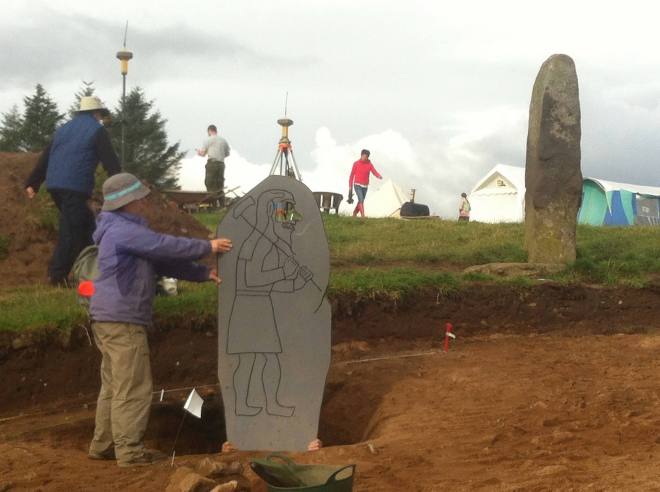 |
| Rhynie Man was here? photo courtesy of Rhynie Man |
I always make the same bad joke about Rhynie Man - I describe him as 'life sized - if you believe I'm life-sized' and here's the evidence to prove it!
Meggen
Planks for the Memories 2015!
In the next few days-weeks we will be posting a recap of our site, features and finds - but for now a quick summary and a gratuitous pun...
It was a fantastic year with some vexing features (curse you annexe ditch!) and great discoveries like our possible stone-hole near the entrance to the outer ditch. Our key thoughts as we turn to writing up this year's results:
The palisade architecture does appear to be complex with massive planks or split timbers set at the inner edge of the foundation cut. The regularity of the palisade post-holes seems pretty convincingly to point to these working together with the supports in the palisade trench and a type of box-rampart superstructure is likely. We have some evidence of additional beams and supports linking palisade postholes, as well, particularly near the entrance to the enclosure.
Our ditches seem largely to have been infilled with windblown sand deposits with the occasional dump of more organic or turfy material. We have good potential for dating some of the lower fills from our investigations into both the inner and outer ditches this year.
The annexe ditch, although substantial in APs and in our drone shots, turned out to be a rather shallow affair. We are still working on the idea of it as a foundation trench for a possible turf wall (with all the turf long gone). The annexe was in use before the palisade was built and before the outer ditch was dug. Our working theory is that this was a livestock enclosure, but mulling continues on that one.
Our finds! More evidence for imported materials, high-level metalworking and ornate dress-sense at the site.
So, a very successful year. Many thanks to the great support of both of our universities, Historic Scotland, Aberdeenshire Council archaeologists, our funders, the volunteers, students, Rhynie Woman and the whole village of Rhynie. More updates to come!
 |
| Ghost planks and split timbers in the palisade trench. |
It was a fantastic year with some vexing features (curse you annexe ditch!) and great discoveries like our possible stone-hole near the entrance to the outer ditch. Our key thoughts as we turn to writing up this year's results:
The palisade architecture does appear to be complex with massive planks or split timbers set at the inner edge of the foundation cut. The regularity of the palisade post-holes seems pretty convincingly to point to these working together with the supports in the palisade trench and a type of box-rampart superstructure is likely. We have some evidence of additional beams and supports linking palisade postholes, as well, particularly near the entrance to the enclosure.
Our ditches seem largely to have been infilled with windblown sand deposits with the occasional dump of more organic or turfy material. We have good potential for dating some of the lower fills from our investigations into both the inner and outer ditches this year.
The annexe ditch, although substantial in APs and in our drone shots, turned out to be a rather shallow affair. We are still working on the idea of it as a foundation trench for a possible turf wall (with all the turf long gone). The annexe was in use before the palisade was built and before the outer ditch was dug. Our working theory is that this was a livestock enclosure, but mulling continues on that one.
Our finds! More evidence for imported materials, high-level metalworking and ornate dress-sense at the site.
So, a very successful year. Many thanks to the great support of both of our universities, Historic Scotland, Aberdeenshire Council archaeologists, our funders, the volunteers, students, Rhynie Woman and the whole village of Rhynie. More updates to come!
Subscribe to:
Posts (Atom)